Knowing how to calculate PPC budget accurately is the foundation of every profitable paid advertising campaign because your budget determines how much visibility you can buy and how fast you can scale.
A well calculated PPC budget helps you avoid overspending on low quality traffic while ensuring you invest enough to generate meaningful results. When your budget is based on data instead of assumptions, every click supports a clear business objective.
Many advertisers struggle with PPC because they treat budgeting as a rough estimate rather than a strategic calculation tied to performance metrics. Without understanding how cost per click, conversion rate, and revenue interact, it becomes impossible to predict outcomes with confidence.
Once you learn how these elements work together, PPC becomes a controllable growth channel instead of a risky expense.
What a PPC Budget Really Represents
A PPC budget is not just the number you set inside an advertising platform because it represents your total investment to acquire traffic, leads, or sales. This budget reflects how much you are willing to spend to achieve specific marketing goals while maintaining acceptable profitability. Viewing your PPC budget this way helps you make smarter, long term decisions rather than reacting emotionally to short term performance changes.
Your PPC budget also reflects the intent behind your campaigns, whether that intent is awareness, lead generation, or direct sales. Different campaign goals require different budgeting strategies, even when targeting the same audience. Without defining intent first, you risk allocating money inefficiently and measuring success incorrectly.
A realistic PPC budget must also allow flexibility because markets, competition, and user behavior change over time. Costs can rise unexpectedly due to increased competition or seasonal demand. A flexible budget allows you to adapt without sacrificing performance or shutting campaigns down prematurely.
Metrics You Must Understand Before Calculating PPC Budget
Before you calculate PPC budget, you must understand the key metrics that determine how efficiently your ads perform. These metrics help you estimate costs, predict outcomes, and evaluate whether your campaigns are profitable. Ignoring them leads to unrealistic budgets and wasted ad spend.
Cost per click is one of the most important inputs in PPC budgeting because it defines how much you pay for each visitor. CPC varies depending on keyword competition, bidding strategy, and ad relevance, which is why many advertisers rely on tools similar to those explained in this guide on how to use a scientific calculator when working through projections. Estimating CPC accurately prevents you from underfunding campaigns or overspending unnecessarily.
Conversion rate is equally critical when planning your PPC budget because it determines how many clicks turn into actual results. A higher conversion rate means you need fewer clicks to achieve your goals. Improving conversion rate is often more cost effective than increasing your budget.
Average order value or lead value connects advertising spend directly to revenue outcomes. This metric shows how much revenue each conversion generates for your business. Without knowing this value, you cannot accurately judge whether your PPC budget is sustainable.
How to Calculate PPC Budget Using a Basic Formula
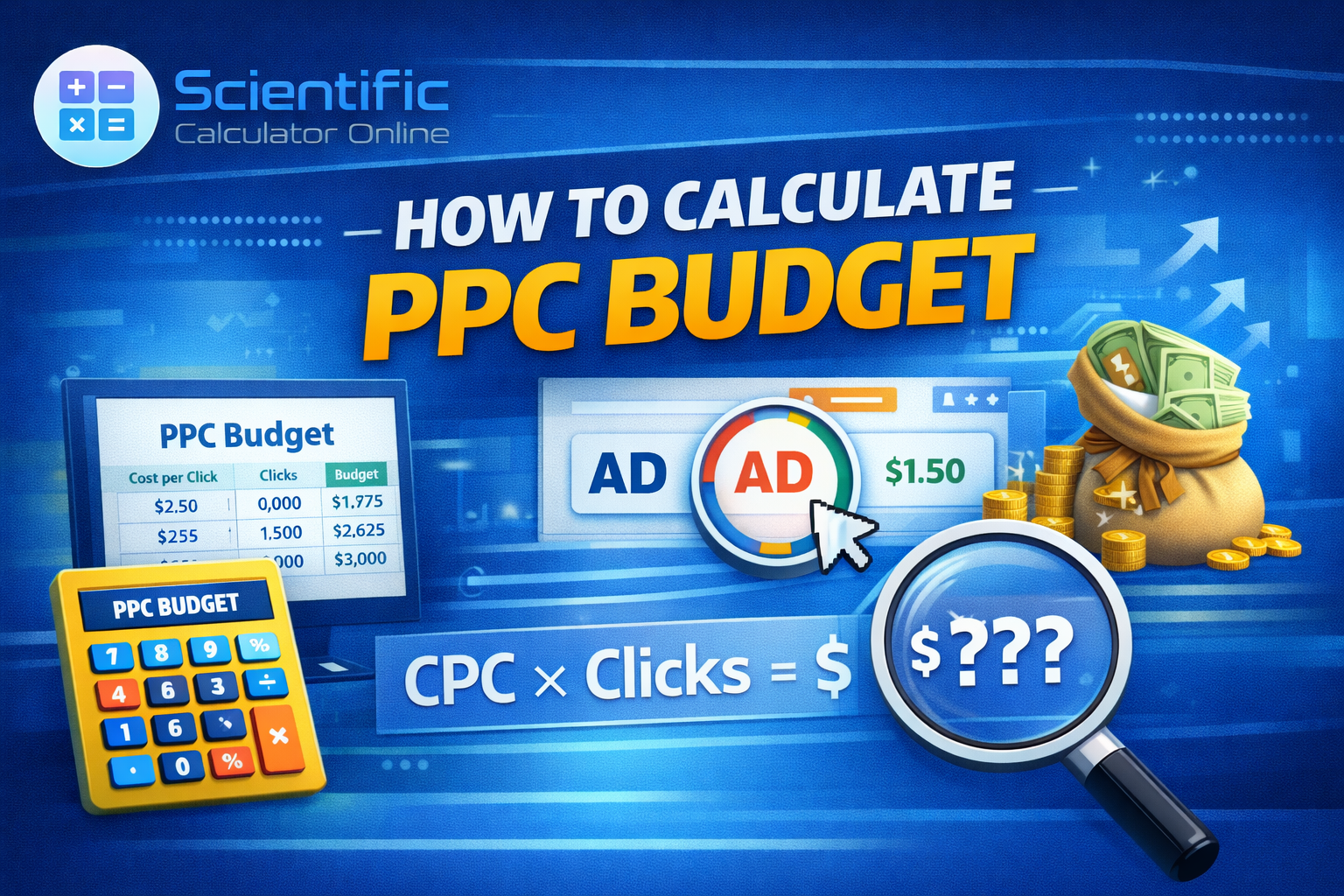
One of the simplest ways to calculate PPC budget is by estimating how many clicks you want per month and multiplying that number by average CPC. This approach works well for new campaigns or when entering a new market. It provides a clear starting point without requiring complex forecasting.
You begin by estimating monthly click volume based on keyword search demand, impression share goals, or historical performance. Many marketers prefer breaking these numbers down step by step, similar to the approach discussed behind the numbers, to avoid guesswork. Once you have this estimate, you multiply it by your expected cost per click to determine budget size.
For example, if you aim for 12,000 clicks per month with an average CPC of one dollar, your PPC budget would be $12,000. This method focuses on traffic volume rather than outcomes like leads or sales. As performance data becomes available, this budget should be refined further.
How to Calculate PPC Budget Based on Revenue Goals
A revenue based approach is one of the most accurate ways to calculate PPC budget because it ties spend directly to business results. Instead of focusing on clicks, you start by defining how much revenue you want to generate. This method ensures your advertising investment aligns with growth objectives.
First, you determine your revenue target for a specific period and divide it by your average order value. This calculation tells you how many sales you need to achieve that target. Converting revenue goals into sales targets creates clarity.
Next, you account for your website conversion rate to estimate how many clicks are required to generate those sales. When working through these calculations, many advertisers follow financial logic similar to the methods outlined in using calculators for accruals and revenues to maintain accuracy. You then multiply the required clicks by average CPC to calculate your PPC budget.
How to Calculate PPC Budget for Lead Generation Campaigns
Lead generation campaigns require a different budgeting approach because success is measured by cost per lead rather than direct revenue. Your PPC budget must align with how many leads your sales team can realistically manage. Generating excessive leads without follow up capacity wastes budget and opportunity.
Start by determining how many qualified leads you need each month to meet sales targets. Then divide that number by your landing page conversion rate to estimate required clicks. This calculation translates lead goals into traffic requirements.
Once you know how many clicks you need, multiply that number by average CPC to calculate your PPC budget. This method highlights inefficiencies quickly when conversion rates are low. Improving landing page performance can significantly reduce required spend.
Factors That Influence PPC Budget Accuracy
Several external and internal factors influence how accurate your PPC budget calculations will be. Competition, seasonality, and ad quality all affect costs and performance. Ignoring these variables often leads to inaccurate forecasts.
Competition has a direct impact on CPC and impression share. In highly competitive industries, higher bids are required to maintain visibility. As competition increases, your PPC budget must adapt accordingly.
Seasonality also affects PPC performance by influencing demand, conversion rates, and costs. Certain times of year drive stronger buying intent and higher CPCs. Planning for seasonality prevents sudden budget strain.
How to Allocate PPC Budget Across Campaign Types
After calculating your total PPC budget, proper allocation becomes essential for maximizing return. Not all campaigns deliver equal value or intent. Smart allocation ensures money flows to the most effective areas.
High intent campaigns such as branded searches and bottom funnel keywords usually deserve the largest share of the budget. These campaigns convert consistently and generate predictable revenue. Prioritizing them stabilizes overall performance.
Mid funnel campaigns support education and consideration by attracting users who are researching options. These campaigns build remarketing audiences and future demand. Allocating the budget here supports long term growth.
Conclusion:
Learning how to calculate PPC budget correctly gives you control over paid advertising outcomes. When your budget is based on data, goals, and realistic assumptions, PPC becomes predictable and scalable. You move from guessing to intentional growth.
A strong PPC budget connects spend to conversions and revenue while allowing room for optimization. You adapt to competition, performance changes, and market shifts over time. This disciplined approach protects profitability and supports long term success.
1. What is a PPC budget?
A PPC budget is the amount you allocate to pay for clicks on ads over a specific time period, controlling how often ads appear and how much traffic you can buy.
2. How do you calculate PPC budget?
You calculate PPC budget by estimating required clicks, multiplying by average cost per click, and adjusting based on conversion rates, revenue goals, and overall marketing objectives for accuracy.
3. Why is PPC budget calculation important?
Proper PPC budget calculation prevents overspending, improves profitability, ensures consistent ad visibility, and helps align paid advertising costs with realistic business goals and expected conversion performance.
4. What metrics are needed to calculate PPC budget?
You need cost per click, conversion rate, target conversions or revenue, average order value, and campaign duration to accurately calculate a PPC budget and forecast performance effectively.
5. How does cost per click affect PPC budget?
Higher cost per click reduces the number of clicks your budget can buy, while lower CPC allows more traffic, making CPC a critical factor in PPC budget planning and efficiency.
6. How do conversion rates impact PPC budgeting?
Conversion rates determine how many clicks are needed for results, meaning higher conversion rates lower required budget, while poor conversion rates increase PPC spending significantly over time.
7. How often should PPC budgets be reviewed?
PPC budgets should be reviewed weekly for pacing and monthly for performance trends to ensure spending remains efficient, aligned with goals, and responsive to market changes.
8. Can small businesses calculate PPC budgets effectively?
Small businesses can calculate PPC budgets by starting with conservative test budgets, focusing on high-intent keywords, monitoring results closely, and scaling gradually based on profitable performance.
9. How do seasonality and competition affect the PPC budget?
Seasonality and competition raise or lower demand and cost per click, requiring flexible PPC budgets to maintain visibility during peak periods and reduce spend when demand declines.
10. Can PPC budgets be optimized without increasing spend?
Yes, PPC budgets can be optimized by improving conversion rates, refining targeting, using negative keywords, and enhancing ad relevance to achieve better results without increasing total spend.