
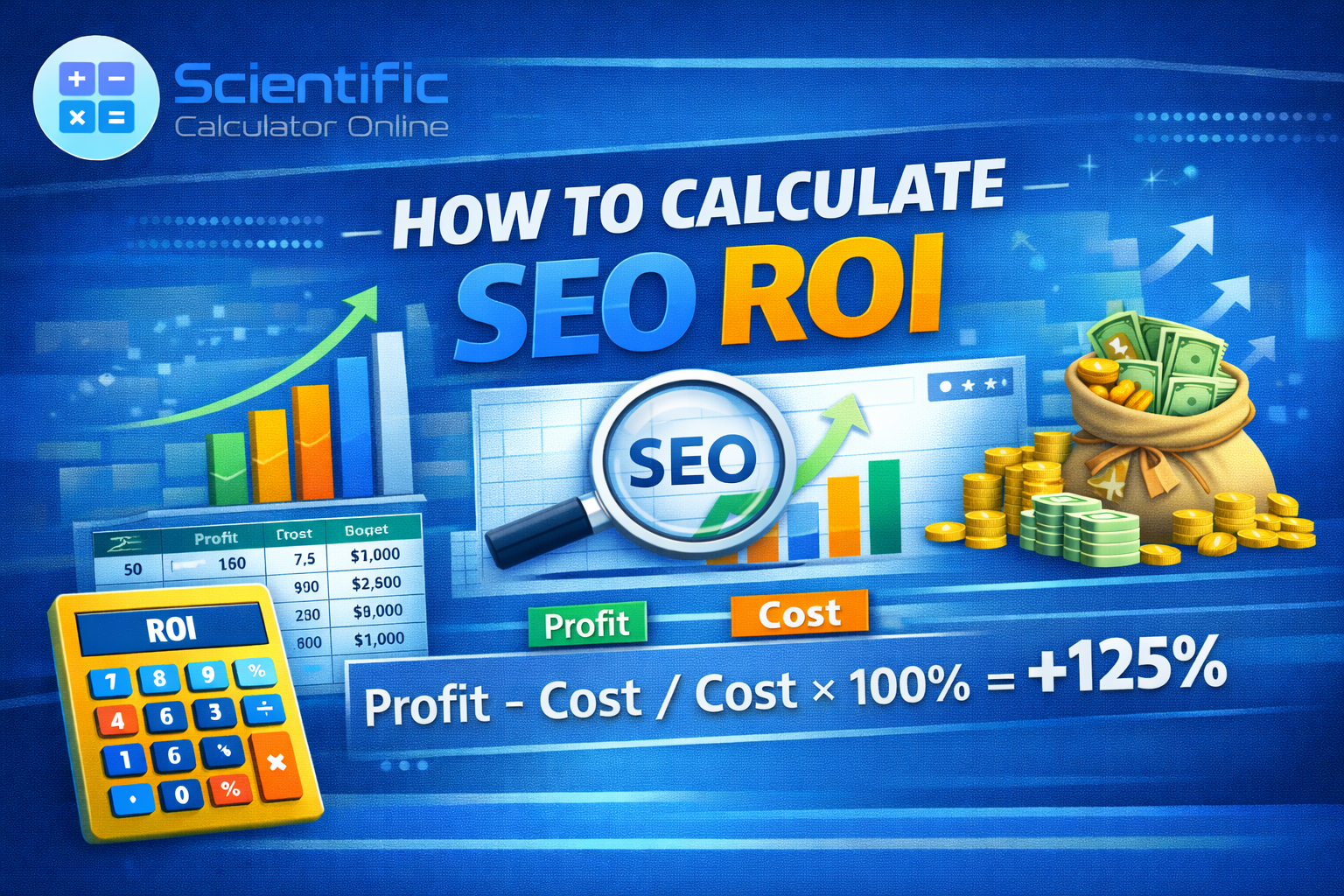
Understanding how to calculate SEO ROI helps you connect search engine optimization efforts directly to measurable business growth. Instead of relying on assumptions, you can quantify performance using revenue, cost, and conversion data. When you calculate SEO ROI correctly, you gain clarity, confidence, and control over your SEO strategy.
SEO ROI is not about rankings alone, and it is not about traffic without purpose. You need to understand how organic visibility translates into real outcomes such as leads, sales, and long-term value. This guide explains how to calculate SEO ROI step by step using practical, realistic methods that work across industries.
What SEO ROI Means and Why It Matters
SEO ROI measures the financial return generated from search engine optimization compared to what you invest in it. It answers a direct question about whether your SEO efforts produce more value than they cost. When you calculate SEO ROI, you move beyond vanity metrics and focus on outcomes that matter to your business.
Many businesses still judge SEO performance based on traffic growth or keyword movement alone. While those indicators matter, they do not explain whether SEO contributes to profitability. Viewing SEO through a financial lens helps you connect optimization work to revenue, efficiency, and scalability.
When you understand SEO ROI, SEO becomes a strategic investment instead of a guessing game. This mindset allows you to prioritize initiatives based on impact and stop spending resources on activities that do not move the needle. Over time, this approach leads to consistent and compounding organic growth.
The Core Formula for Calculating SEO ROI
The foundation of how to calculate SEO ROI is a simple and universally accepted formula. You subtract your total SEO costs from the revenue generated through organic search, divide that number by the SEO cost, and multiply by one hundred. The result shows your ROI as a percentage.
SEO ROI equals organic revenue minus SEO cost, divided by SEO cost, multiplied by one hundred. A positive percentage means your SEO efforts are profitable, while a negative number signals that costs exceed returns. This formula works for ecommerce, SaaS, and lead-based businesses alike.
To apply this formula correctly, you must ensure that both revenue and costs are accurate. If either side is incomplete or inflated, the ROI calculation becomes misleading. Precision at this stage is essential for trustworthy SEO performance evaluation.
Identifying All SEO Costs Correctly
To calculate SEO ROI accurately, you must first identify every cost associated with your SEO efforts. This includes agency retainers, freelance services, SEO tools, analytics platforms, and content production expenses. Ignoring any of these costs creates an incomplete ROI picture.
Internal resources are often overlooked when calculating SEO investment. Time spent by writers, developers, marketers, and strategists carries real monetary value. Treating internal labor as free leads to inflated ROI numbers that do not reflect reality.
You should also account for one-time and ongoing SEO expenses together. Technical audits, site migrations, content refreshes, and optimization projects all contribute to your total investment. Viewing SEO costs holistically helps you evaluate performance with clarity and fairness.
Measuring Revenue from Organic Search
Revenue attribution is the most critical part of how to calculate SEO ROI. You need to determine how much money your business generates directly from organic search traffic. This typically involves analytics platforms that track conversions and revenue by acquisition channel.
For ecommerce websites, organic revenue measurement is relatively straightforward. You can attribute transactions and revenue directly to organic sessions. For service-based or lead-driven businesses, revenue tracking requires assigning values to leads based on close rates and average deal sizes.
Understanding revenue data requires looking beyond surface numbers and focusing on outcomes. Reviewing historical performance, sales cycles, and conversion quality helps you estimate organic revenue more accurately. If you want deeper insight into performance analysis and data interpretation, reviewing content that explores trends behind the numbers can help you connect metrics to meaningful outcomes.
Understanding Conversion Rates and User Intent
Conversion rate plays a central role in how to calculate SEO ROI because it determines how efficiently organic traffic turns into value. High traffic volumes do not guarantee strong ROI if visitors fail to convert. Conversion optimization directly improves SEO profitability without increasing acquisition costs.
User intent influences conversion performance more than keyword volume. Informational queries attract research-focused users, while commercial and transactional queries attract buyers. Evaluating intent allows you to prioritize keywords that generate revenue instead of just visits.
Improving conversion rates strengthens ROI even if traffic remains stable. Clear messaging, faster pages, and relevant content all contribute to higher conversion efficiency. Aligning SEO efforts with user intent creates measurable financial gains.
Accounting for Customer Lifetime Value
Customer lifetime value adds depth and accuracy to how you calculate SEO ROI. Instead of focusing only on the first conversion, you consider the total revenue a customer generates over time. This perspective is essential for subscription models and repeat-purchase businesses.
Organic search often attracts users with stronger intent and higher trust. These users tend to stay longer, engage more, and purchase repeatedly. Including lifetime value reveals the full impact of SEO on long-term revenue growth.
Using conservative lifetime value estimates keeps ROI projections realistic. Base calculations on historical customer data rather than assumptions. When combined with revenue tracking, lifetime value turns SEO ROI into a forward-looking decision tool.
Projecting SEO ROI Over Time
SEO ROI rarely appears immediately, and understanding time-based performance is essential. Early stages often show negative or flat ROI as costs accumulate before rankings improve. Over time, consistent optimization produces compounding returns.
When projecting SEO ROI, you should evaluate performance across multiple months rather than short windows. This approach helps you identify breakeven points and long-term profitability. Long-term modeling supports better budgeting and expectation management.
SEO compounds because optimized pages continue generating traffic without proportional cost increases. Unlike paid channels, organic growth becomes more efficient as authority builds. This compounding effect makes SEO one of the strongest long-term ROI drivers.
Common Mistakes When Calculating SEO ROI
One of the most common mistakes in how to calculate SEO ROI is focusing only on traffic metrics. Traffic without conversions does not generate revenue and can distort performance evaluation. ROI requires tying organic sessions to tangible outcomes.
Another mistake is ignoring assisted conversions and attribution complexity. Organic search often supports other channels in the conversion journey. Excluding this influence undervalues SEO’s real contribution.
Overestimating revenue or underestimating costs also leads to misleading conclusions. Accurate SEO ROI depends on honest inputs and disciplined measurement. Avoid shortcuts if you want reliable insights.
Improving SEO ROI Through Strategic Optimization
Once you understand how to calculate SEO ROI, you can actively work to improve it. Targeting high-intent keywords increases conversion potential without increasing traffic volume. Strategic content updates often deliver significant ROI improvements.
Technical SEO enhancements also raise ROI by improving site performance and usability. Faster load times, cleaner architecture, and better crawlability improve both rankings and conversions. These improvements increase revenue efficiency across organic traffic.
Design and user experience play a major role in conversion-driven SEO ROI. Optimized layouts, trust signals, and navigation increase engagement and sales, especially for online stores. Applying proven approaches for optimized ecommerce site design can significantly improve organic conversion rates.
Using SEO ROI to Guide Business Decisions
SEO ROI provides clarity when allocating marketing budgets across channels. Knowing the financial return of organic search allows you to compare SEO with paid media, email, and social marketing. This insight leads to smarter resource distribution.
Clear ROI reporting also improves communication with stakeholders and decision-makers. Financial metrics are easier to understand and trust than abstract SEO indicators. SEO ROI transforms optimization work into measurable business performance.
Tracking ROI over time helps you refine strategy continuously. When you monitor results consistently, you can identify growth opportunities and eliminate inefficiencies. Advanced performance tracking methods used to measure loyalty and repeat revenue can further refine ROI accuracy, especially when paired with analytics-driven evaluation.
Conclusion
Knowing how to calculate SEO ROI gives you full visibility into the financial impact of your SEO strategy. By tracking accurate costs, measuring real revenue, and considering long-term value, you gain a reliable framework for evaluation. This clarity helps you invest confidently and optimize what works.
SEO ROI is not about short-term wins or isolated metrics. It reflects how effectively organic search supports sustainable growth. When calculated correctly and reviewed consistently, SEO ROI becomes a powerful guide for smarter marketing decisions.
FAQ’s
How do you calculate SEO ROI accurately for your business?
You calculate SEO ROI by subtracting your total SEO costs from organic search revenue, dividing the result by total SEO costs, and multiplying by one hundred. Accurate tracking of revenue and costs is essential for reliable results.
What costs should you include when calculating SEO ROI?
You should include all SEO-related expenses such as agency fees, in-house labor time, SEO tools, content creation costs, technical optimization work, and any one-time or recurring investments directly supporting organic search performance.
How do you measure revenue from SEO for lead-based businesses?
For lead-based businesses, SEO revenue is measured by assigning monetary values to leads using close rates and average deal sizes. This method connects organic traffic to real sales outcomes rather than relying on traffic volume alone.
How long does it take to see a positive SEO ROI?
SEO ROI typically takes several months to become positive because rankings and traffic grow gradually. Most businesses see meaningful returns between four and twelve months, depending on competition, strategy quality, and consistency of optimization efforts.
Why is SEO ROI harder to calculate than paid advertising ROI?
SEO ROI is harder to calculate because organic traffic has no fixed cost per click and often assists conversions indirectly. Attribution across multiple touchpoints makes isolating SEO’s exact revenue contribution more complex than paid campaigns.
What role do conversion rates play in SEO ROI?
Conversion rates directly affect SEO ROI because they determine how efficiently organic traffic turns into revenue. Improving conversion performance can significantly increase ROI without increasing traffic, making optimization a critical part of SEO success.
Should customer lifetime value be included in SEO ROI calculations?
Customer lifetime value should be included when calculating SEO ROI, especially for subscription or repeat-purchase businesses. It reflects the full revenue impact of organic customers and provides a more accurate picture of long-term SEO profitability.
What are common mistakes when calculating SEO ROI?
Common mistakes include ignoring internal labor costs, focusing only on traffic metrics, overestimating revenue, and excluding assisted conversions. These errors distort results and prevent you from understanding SEO’s true financial impact.
How often should you calculate and review SEO ROI?
You should review SEO ROI regularly, usually monthly or quarterly, to track performance trends. Consistent analysis helps you identify what works, adjust strategy early, and improve long-term returns from organic search.
How can you improve SEO ROI over time?
You can improve SEO ROI by targeting high-intent keywords, optimizing conversion paths, improving technical performance, and updating high-performing content. Continuous measurement and refinement ensure SEO investments generate increasing returns over time.