
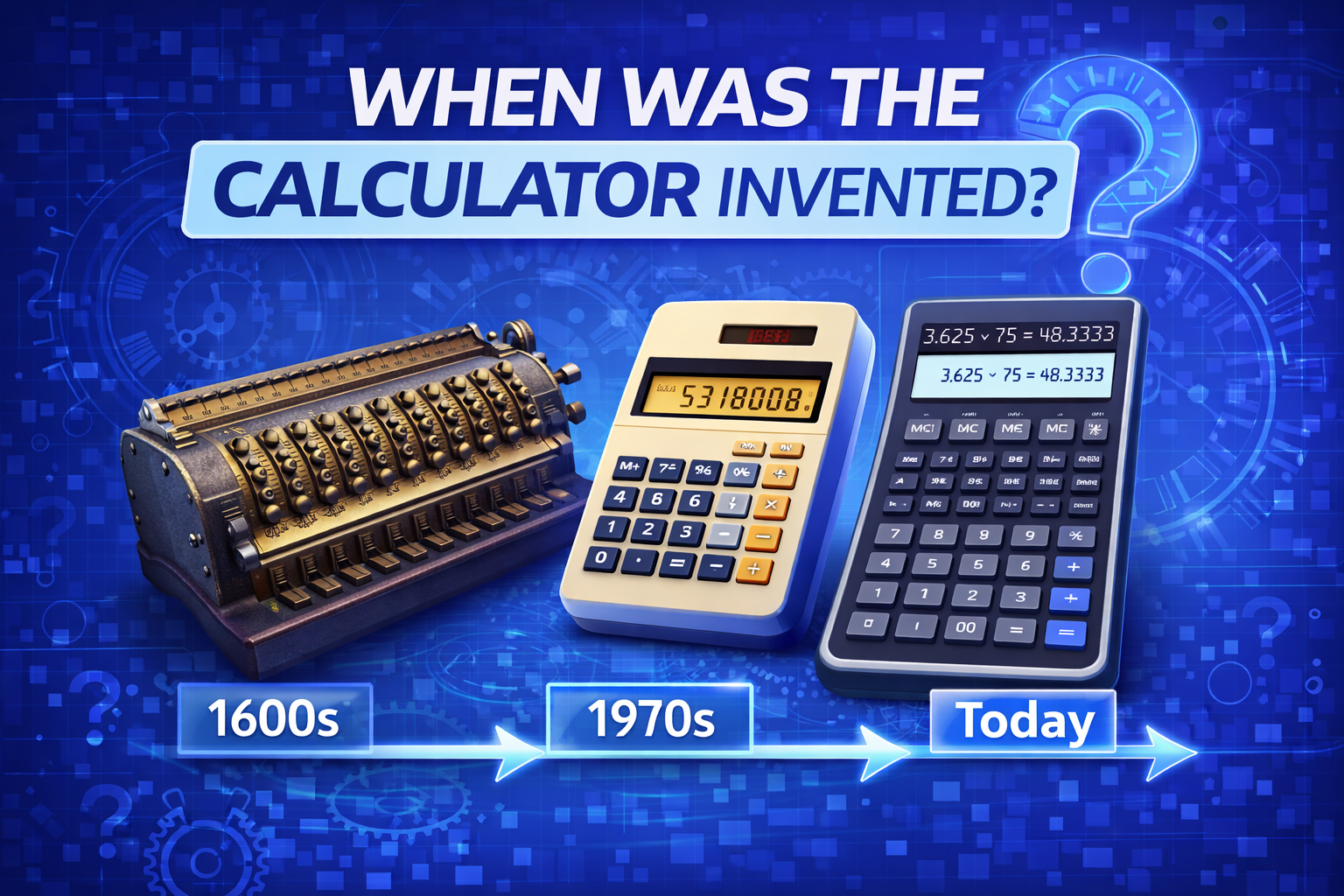
When was the calculator invented, and who deserves the credit for this essential device? You may assume it appeared in the twentieth century, yet its origins stretch back thousands of years.
In this guide, you will trace the complete evolution of calculators, from ancient counting tools to modern pocket and web-based devices, so you understand exactly when and how the calculator was invented.
The Earliest Calculation Tools in Human History
If you want to know when the calculator was invented, you must begin long before electricity. Ancient civilizations used tools such as tally sticks, counting boards, and the abacus to perform arithmetic efficiently. The abacus, used in Mesopotamia and later in Asia, allowed merchants and officials to calculate sums with remarkable speed and accuracy.
You should not think of these devices as primitive, because they laid the foundation for mechanical logic. The abacus introduced positional value systems that remain central to modern computation. Even today, skilled users can outperform electronic devices in simple calculations using this ancient tool.
These early systems prove that the concept of a calculator existed thousands of years ago. However, they were manual devices that relied entirely on human operation. To answer when the calculator was invented in its mechanical form, you must move forward to the seventeenth century.
The First Mechanical Calculator in 1623
In 1623, German mathematician Wilhelm Schickard designed what many historians recognize as the first mechanical calculator. He called it the Calculating Clock, and it could add and subtract six-digit numbers using a system of rotating gears. Letters written to Johannes Kepler confirm the machine’s design, even though the original device was lost.
You may notice that this invention predated many famous scientific breakthroughs. Schickard combined gear-driven wheels with a multiplying mechanism inspired by Napier’s bones. This hybrid approach marked the first attempt to automate arithmetic mechanically rather than manually.
Although the machine was not mass-produced, it introduced the essential concept of automated carry-over in addition. That innovation became the backbone of later mechanical calculators. Therefore, 1623 is often cited as a critical milestone in the history of calculator invention.
Blaise Pascal and the Pascaline in 1645
In 1645, French mathematician Blaise Pascal introduced the Pascaline, one of the earliest working mechanical calculators. He built the device to help his father calculate taxes more efficiently, showing how real-world problems drive technological advancement. The Pascaline could add and subtract by turning dials connected to interlocking gears.
You should understand that Pascal’s machine solved a persistent challenge in arithmetic automation. It handled carry-over automatically, which reduced human error in repetitive calculations. Historians often credit Pascal as a co-inventor of the calculator because his design was functional and publicly demonstrated.
Although the Pascaline was expensive and difficult to manufacture, it proved that mechanical calculation was practical. It also inspired future inventors to refine gear-driven arithmetic machines. Therefore, many people answer the question when the calculator was invented by pointing to 1645.
Commercial Success in 1820: The Arithmometer
In 1820, Charles Xavier Thomas de Colmar introduced the Arithmometer, the first commercially successful mechanical calculator. Unlike earlier prototypes, this machine performed addition, subtraction, multiplication, and division reliably. It remained in production for decades and became widely used in business and government offices.
You should recognize that commercial success changed everything. The Arithmometer transformed calculators from experimental devices into essential office tools. By the late nineteenth century, thousands of mechanical calculators were in operation worldwide.
This period marked the transition from invention to industry. The calculator was no longer a scientific novelty but a practical instrument for large-scale financial and engineering tasks. That development firmly established the calculator as a permanent fixture in professional environments.
The Rise of Electronic Calculators in the 1950s
The next major shift occurred in the 1950s with the introduction of electronic calculators. In 1954, IBM released the 608, the first all-transistor calculator, which replaced bulky mechanical components with electronic circuits. This innovation dramatically increased speed and reliability while reducing mechanical wear.
You should note that early electronic calculators were massive and expensive. Some units weighed hundreds of pounds and cost tens of thousands of dollars. Despite their size, they demonstrated the immense potential of transistor-based computation.
By the late 1950s, companies such as Casio introduced more compact all-electric desktop calculators. These machines paved the way for the portable revolution that followed. They also signaled the beginning of modern electronic computing in everyday applications.
The Handheld Breakthrough of the 1960s and 1970s
The real transformation happened when calculators became portable. In 1967, Texas Instruments developed a handheld prototype known as Cal Tech, and by 1971 the Busicom LE-120A became the first true pocket-sized electronic calculator. It featured an integrated circuit that condensed complex processing into a single chip.
You should understand that this shift made calculators accessible to students and consumers. Prices dropped rapidly throughout the 1970s, turning calculators into common classroom tools. According to industry reports, millions of pocket calculators were sold annually by the mid-1970s.
Handheld devices redefined education and professional work. Students could now solve equations instantly without mechanical devices or slide rules. This era firmly answers the modern version of when was the calculator invented for everyday use: the early 1970s.
The Programmable Era and Advanced Functions
In 1974, Hewlett-Packard introduced the HP-65, the first programmable handheld calculator. It allowed users to store instructions on magnetic cards, effectively transforming the device into a miniature computer. Engineers and scientists quickly adopted programmable calculators for complex calculations.
You should see this development as a bridge between calculators and computers. Programmable models could solve trigonometric, logarithmic, and statistical problems automatically. They expanded the calculator’s role from simple arithmetic to advanced scientific computation.
Modern scientific devices evolved from this foundation, offering high-performance capabilities in compact formats. If you want practical insight into device functionality, understanding how features evolved from programmable models is essential.
The Graphing Calculator Revolution
In 1985, Casio introduced the fx-7000G, widely recognized as the first graphing calculator. This device allowed you to visualize equations directly on a screen, which transformed math education. Instead of calculating isolated numbers, you could now interpret entire functions visually.
You should appreciate how graphing technology improved conceptual learning. Teachers began incorporating graphical analysis into algebra and calculus instruction. By the 1990s, graphing calculators became standard requirements in many American high schools.
To understand the distinction between device categories, you can examine the detailed comparison in scientific calculator vs graphing calculator, which clarifies functional differences that emerged during this era. That distinction highlights how calculators diversified into specialized tools.
How Modern Scientific Calculators Evolved
Today’s devices combine decades of refinement into compact and powerful instruments. A modern scientific calculator handles trigonometric functions, logarithms, statistical analysis, and scientific notation with ease. These capabilities reflect the steady accumulation of innovations since the seventeenth century.
If you want to understand core functionality, you can review the explanation in what is a scientific calculator, which outlines how these tools extend beyond basic arithmetic. That evolution demonstrates how calculators transitioned from mechanical gears to microprocessors executing millions of operations per second.
You now carry in your pocket computational power that once required room-sized machines. This technological leap underscores how rapidly calculator development accelerated after the transistor era. It also reinforces why defining a single invention date oversimplifies the story.
The Impact of Web-Based Calculator Tools
The calculator’s journey did not stop with handheld devices. Web-based platforms now allow you to perform advanced calculations instantly without purchasing hardware. Digital tools have made high-quality computation accessible from any browser.
If you prefer immediate access without installing software, you can rely on Scientific Calculator Online for fast and accurate results. This type of web-based solution reflects how calculators continue evolving alongside internet technology.
You benefit from decades of innovation condensed into a simple interface. The transition from mechanical gears to cloud-based tools illustrates how the calculator adapted to every technological era. It also demonstrates how accessibility remains central to its evolution.
Conclusion
When the calculator was invented depends on how you define the term. If you consider the earliest calculating tool, the answer reaches back thousands of years to the abacus. If you focus on mechanical automation, you arrive at 1623 or 1645 with Schickard and Pascal.
If you define invention as commercial practicality, 1820 stands out with the Arithmometer. If you prioritize electronic portability, the early 1970s represent the modern calculator’s true birth. Each milestone represents a different stage in a continuous innovation process.
You should therefore view the calculator not as a single invention but as a layered technological evolution. From ancient beads to microchips and web-based platforms, every generation improved speed, accuracy, and usability. Understanding this progression gives you a precise and complete answer to when the calculator was invented, grounded in history rather than a single date.