The weather is something that impacts our everyday lives.
One of the more common examples would be checking whether it will rain or not to see if we should take an umbrella when going outside. Obviously, there are other examples (e.g., checking the weather before planning a trip or knowing how to dress). These are some minute examples where we use the forecast to prepare and plan for various occasions. Most of these checks are simple: it’s either going to be warm or cold, it’s either going to rain or not, there’s going to be snow or fog, and so forth.
As simple and trivial as it seems, predicting the weather is something that is far more complex than most of us realize.
Despite all the technological advancements we have made, always correctly predicting the weather is something that we can’t do.
But despite our limitations, we are still able to discern weather patterns to a certain degree of success through calculations and data analysis.
How Weather Data is Collected and How it is Measured
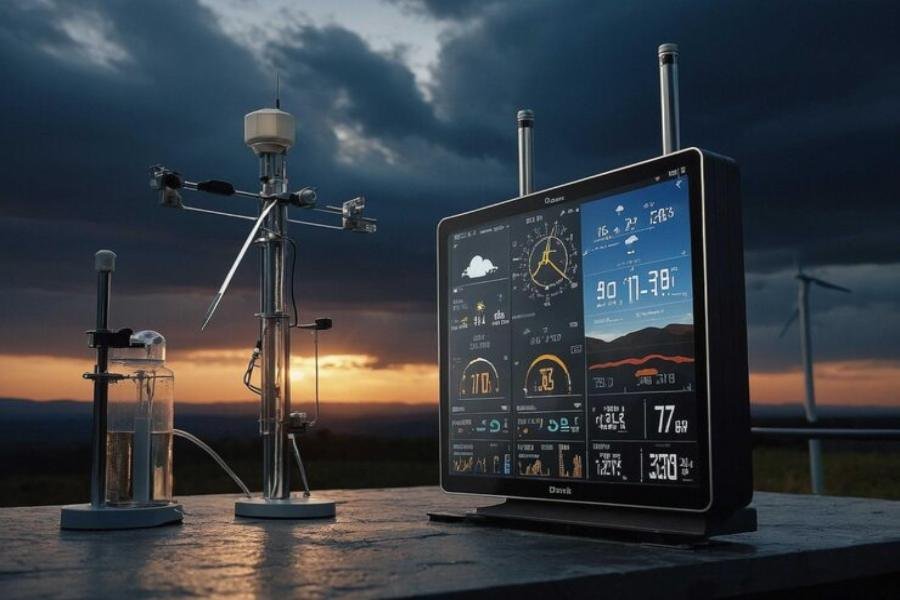
Meteorologists use a lot of different instruments and technologies to measure the conditions of the atmosphere.
Each type of data provides a piece of a puzzle that helps them to predict what the weather will do next.
Most of the information and data is distributed through a free global weather data API. Having all these accurate data points will allow organizations (and businesses) to work with the same atmospheric datasets as those that professional meteorologists use.
- Temperature and Humidity Sensors – These are devices that measure the temperature and the moisture content.Temperature affects the density and movement of air, and humidity affects cloud formation and precipitation.
- Barometers – Barometers measure atmospheric pressure. High pressure is generally indicative of clear skies. Low-pressure systems can be indicative of coming storms.
- Anemometers – These tools are used to measure wind speed and direction. Anemometers are a useful tool inforecasting storms and determining how weather systems are moving across regions. Wind can also impact temperature readings, precipitation, and even air quality.
- Images from Radars and Satellites – Weather radars detect precipitation. They also detect rain, snow, and hail. This technology allows meteorologists to monitor both conditions on a local scale and those on a wider scale.
Each of these measurements provides one piece of a puzzle. When these pieces are combined, they create the big picture that is used for more accurate predictions.
Collecting Data in Weather Forecasting
Collecting data is an essential activity when it comes to weather forecasts, but what matters more than simply collecting data and what is far more complicated is accurately analyzing it.
- Equations of Motion – Meteorologists use physics-based equations to model how air masses move and interact.
- Thermodynamic – Heat, moisture, energy, etc. All these factors will determine cloud formation, precipitation, storms, etc.
- Statistical Models – Historical weather data is analyzed to improve forecast accuracy.
- Numerical Weather Prediction – This approach uses supercomputers to simulate the atmosphere. Millions of calculations are performed simultaneously to predict future weather conditions.
Even slight errors in measurement can significantly affect the accuracy of the forecast. That is why meteorologists always keep improving their instruments and methods in order to make their predictions as reliable as possible.
Weather Forecast Applications
Weather and weather forecasts have real-world consequences. Consequences that can measurably impact various industries.
Here are a couple of industry examples that would be most affected:
Agriculture
Farmers are at the mercy of the weather at all times. Irrigation and crop protection are shaped around weather patterns (both current and future predictors). Without reliable weather data, agriculture would be only a fraction as effective as it currently is.
Logistics/Shipping
In order to plan for safe and efficient routes, industries such as airlines, shipping companies, and trucking firms use weather data to base their business around weather patterns and are heavily reliant on accurate weather data in order to bereliable.
Construction
Building takes time, and a heavy rainshower can ruin a fresh concrete pour. But construction in general takes time, and having accurate and detailed knowledge of what the weather’s going to be like will enable project managers to better plan tasks.
Energy
Both wind and solar farms are heavily reliant on weather to produce sufficient energy outputs. Solar farms require sunny days. Wind turbines require strong winds. Having historical weather knowledge of a specific area enables investors to find opportunities for more clean energy farms.
Information is power, and that power can be used to better optimize operations and make better and more informed decisions on what approach to take and when.
Conclusion
Although weather forecasting seems like a simple activity at first glance, it’s in fact one of the more complex endeavors that humanity has undergone. It’s a combination of sciences, like mathematics, physics, and engineering.
And despite the amalgamation of all this knowledge, accurately predicting the weather is still something that eludes us.
There’s much more to it than what most people realize. From temperature sensors to numerical models, all the way to the combination of observation and complex calculations. It could be said that we are in our infancy when it comes to predicting the weather. Yet, despite all the barriers, the weather forecast still continues to evolve, and predictive models continue to improve.
As the models and technologies improve, we will gain more insight into the intricacies of weather forecasting, and with it, we’ll be able to more fully utilize that knowledge to make better and more informed decisions that will allow for stronger and more efficient operations.