
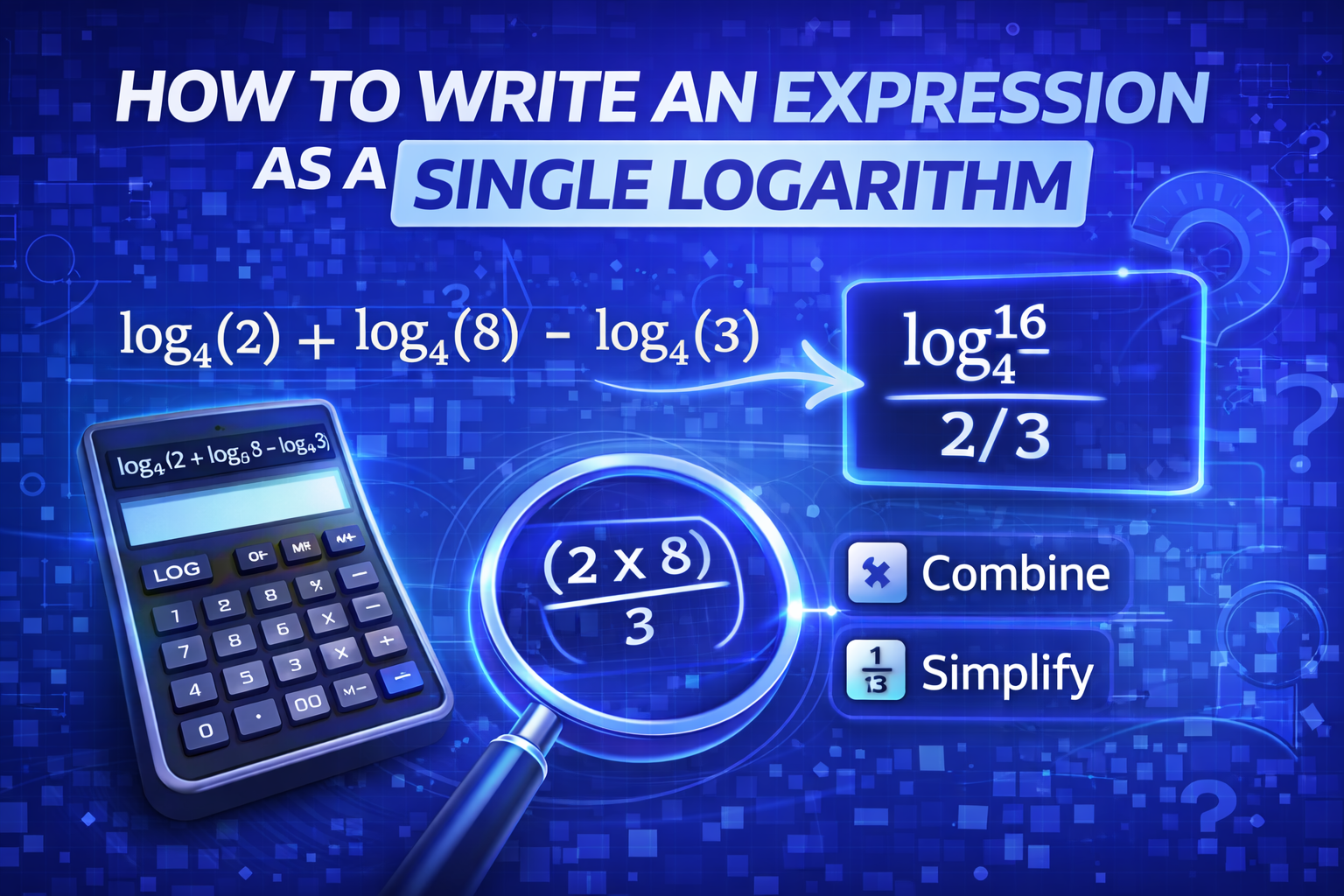
When you combine several logarithms into one, you make equations easier to simplify, solve, and verify without losing accuracy. You do it by applying the product, quotient, and power rules in a consistent order, then checking that every value inside each log stays positive.
This guide shows you how to write an expression as a single logarithm with clean steps, practical examples, and quick ways to catch common mistakes.
Know the Three Log Rules You Will Use Every Time
You can rewrite most log expressions as a single logarithm by relying on three properties that never change across bases. You turn addition into multiplication inside one log, you turn subtraction into division inside one log, and you turn a coefficient into an exponent inside one log.
You will move back and forth between these forms so often that you should treat them as a small toolkit you apply in the same sequence each time.
Start by Converting Coefficients Into Exponents
You should handle any coefficient in front of a log first because it controls the largest structural change you will make. When you see something like 5 log(3), you rewrite it as log(3^5), which keeps the meaning the same while preparing the expression for combining. After you convert every coefficient this way, you will usually find that the remaining problem becomes a straightforward product or quotient inside one logarithm.
Combine Added Logs With the Product Rule
You can combine logs that are added because addition outside a log becomes multiplication inside a log. If you have log(A) + log(B), you write it as log(AB), and you keep the same base for every term you combine.
If you want a quick check while practicing, you can compute the inside product and see whether the single log matches the original expression’s behavior over valid inputs, and using a tool like Scientific Calculator Online can help you verify numerical values without changing your algebra.
Combine Subtracted Logs With the Quotient Rule
You can combine logs that are subtracted because subtraction outside a log becomes division inside a log. If you have log(A) − log(B), you write it as log(A/B), and you keep careful track of what stays in the numerator and what moves to the denominator. When multiple minus signs appear, you should combine left to right so you do not accidentally invert a factor, especially when letters like x and y appear as separate log terms.
Mix Addition and Subtraction by Building One Fraction First
You should treat a mixed expression like log(A) + log(B) − log(C) as a single fraction inside one log. You first combine the added terms into a product AB, then place the subtracted term C in the denominator, giving log(AB/C). If your expression includes several subtractions, you can keep stacking factors in the denominator until you reach one clean ratio that you can simplify with basic algebra.
Keep Bases Consistent Before You Combine Anything
You can only combine logarithms directly when they share the same base, so you must check the base before you apply product or quotient rules. If one term uses log (base 10 by convention), another uses ln (base e), or another uses log base 2, you cannot merge them as written without converting.
If you are practicing with base conversions, the keystrokes and display modes discussed in how to use a scientific calculator can help you confirm which base your calculator is using while you keep your algebra consistent.
Use Factoring and Simplification Inside Logs to Clean the Final Result
You should simplify what sits inside the log once you have condensed the expression, because a clean inside expression improves readability and helps you spot restrictions. If you end with log((x^2 − 4)/(x − 2)), you can factor x^2 − 4 into (x − 2)(x + 2) and then cancel the (x − 2) factor where it is valid. You must remember that canceling changes the simplified form but it does not remove the original restriction, so you still exclude values that made the original denominator zero.
Check Domain Restrictions Before You Call the Answer Finished
You should always check domain restrictions because logarithms only accept positive inputs and because denominators cannot equal zero. When you condense logs into one fraction, you must enforce that every factor in the numerator and denominator stays positive where it originally appeared, not just in the final simplified form. This domain step prevents “correct-looking” answers that fail for some x values, which matters when you solve equations or interpret graphs.
Work Through a Classic Example Step by Step
You can condense 5 log(3) + log(4) by applying the power rule first and the product rule second. You rewrite 5 log(3) as log(3^5), then combine log(3^5) + log(4) into log(3^5 · 4), which is one logarithm. If you compute 3^5 as 243, you get log(972), and you should recognize that the base remains the same as the original logs unless the problem states a different base.
Quick Self Check You Can Use on Any Example
You can test your condensed result by expanding it back using the same rules in reverse. You start with your single log and split products into sums, split quotients into differences, and pull exponents back out as coefficients.
If you return to the original expression exactly, you have a strong confirmation that your condensation steps stayed accurate.
Handle Variables by Grouping Like Factors and Avoiding Sign Errors
You should be extra deliberate when variables appear because one sign mistake can move an entire factor to the wrong side of a fraction. For an expression like log(5) − log(x) − log(y), you combine it as log(5/(xy)) and you remember that both x and y belong in the denominator as a product.
If you need a quick way to confirm the placement, you can plug in simple positive values like x = 2 and y = 3 and compare the original and condensed forms to see if they match.
Common Mistakes That Cost Points and How You Avoid Them
You avoid most errors by following a consistent order and by checking meaning after each transformation. The most common mistakes include forgetting to convert coefficients into exponents, combining different bases as if they match, and dropping domain restrictions after canceling factors. You can also reduce mistakes by watching for these patterns as you work.
- You must convert k log(A) into log(A^k) before combining with other log terms.
- You must keep subtraction as division, so log(A) − log(B) becomes log(A/B) and not log(B/A).
- You must keep every log input positive, and you must keep every denominator nonzero, even after simplification.
- You must not combine ln terms with log terms unless you rewrite them to a shared base.
Practice Strategy That Improves Speed Without Sacrificing Accuracy
You will get faster when you practice with a repeatable checklist rather than relying on memory alone. You first scan for coefficients, then you scan for plus and minus signs, then you scan for bases, and only then do you start rewriting.
Once your final single log is written, you simplify the inside and confirm domain restrictions, and if you want targeted calculator practice for log keys and modes, you can apply the steps from How to use log on scientific calculator while keeping your algebra steps clear and separate.
Conclusion
You can write an expression as a single logarithm by converting coefficients into exponents, turning addition into multiplication, and turning subtraction into division while keeping bases consistent.
You strengthen every answer when you simplify the inside expression carefully and enforce the domain restrictions that keep log inputs positive and denominators nonzero. When you practice with a fixed order and verify by expanding backward, you build accuracy you can trust on homework, tests, and real problem-solving.