
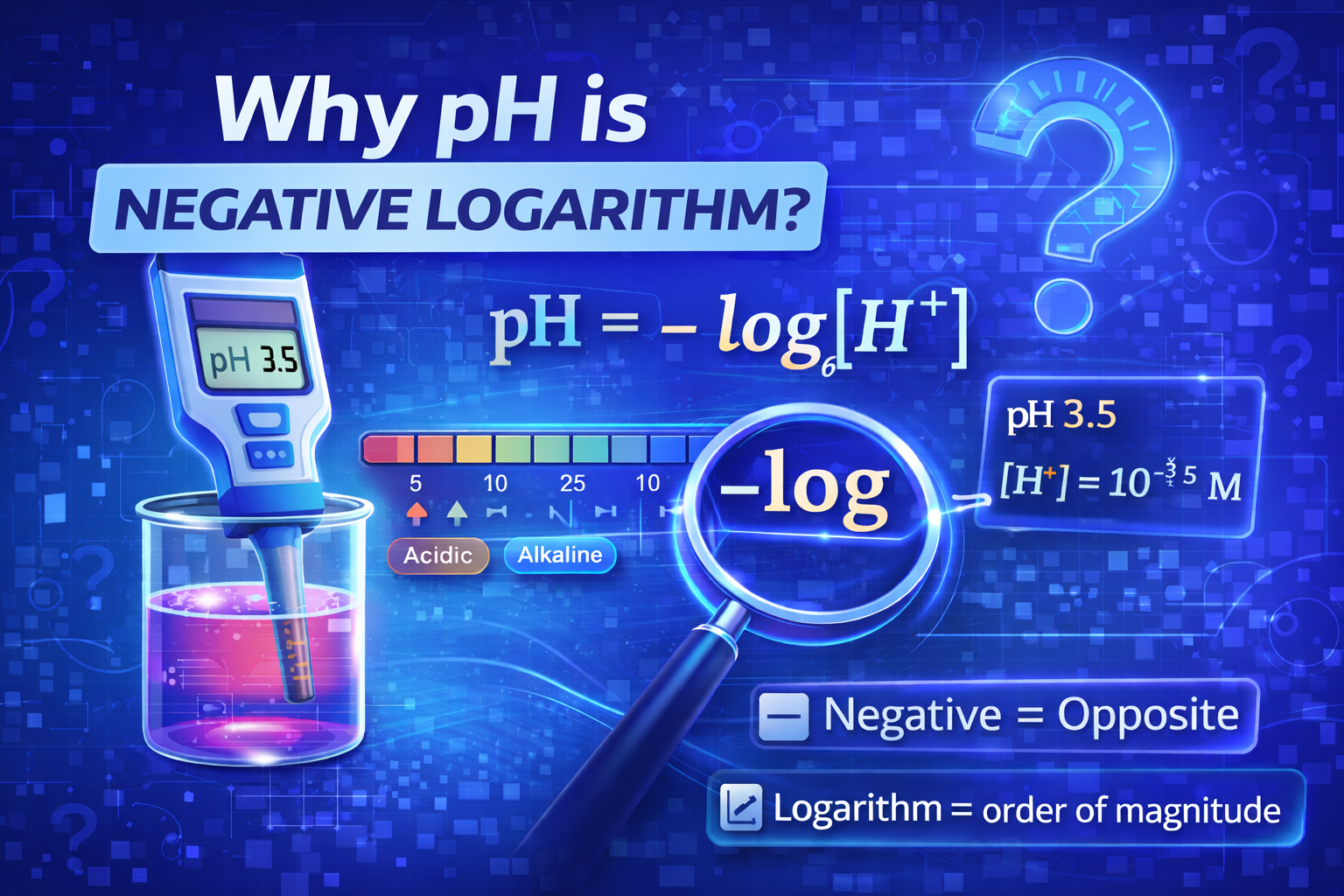
Understanding why pH is negative logarithm helps you grasp how chemists measure acidity with precision and clarity. When you see a pH value, you are looking at a compact mathematical expression of hydrogen ion activity in water.
If you read this article carefully, you will understand the science, the math, and the real world importance behind that small but powerful number.
The Meaning of pH in Chemistry
When you ask why pH is negative logarithm, you must first understand what pH represents in solution chemistry. The term pH refers to the power of hydrogen, where the capital H stands for hydrogen ions, and it specifically measures the activity of hydrogen ions in aqueous solutions. You use this scale to determine whether a solution is acidic, neutral, or basic with scientific accuracy.
In pure water at 25 degrees Celsius, hydrogen ion concentration equals 1.0 × 10⁻⁷ moles per liter. Because the ion product constant of water, Kw, equals 1.0 × 10⁻¹⁴ at this temperature, the sum of pH and pOH equals 14 under standard conditions. This relationship explains why many textbooks refer to the common pH range of 0 to 14, although extreme conditions can extend beyond that range.
Why Chemists Use a Logarithmic Scale
The reason pH is negative logarithm lies in the enormous range of hydrogen ion concentrations found in real solutions. Hydrogen ion concentrations can vary from values like 1 mole per liter in strong acids down to 1 × 10⁻¹⁴ moles per liter in strong bases. If you tried to compare these numbers directly, you would struggle with long strings of zeros and powers of ten.
A logarithmic scale compresses that range into manageable whole numbers and decimals. A change of one pH unit represents a tenfold change in hydrogen ion activity, which means a solution at pH 4 is ten times more acidic than a solution at pH 5. This compression makes analysis practical, especially in environmental science, medicine, and industrial chemistry.
Why the Logarithm Is Negative
You may wonder why the logarithm includes a negative sign instead of simply using log of the concentration. Hydrogen ion concentrations in water are typically less than 1 mole per liter, which means their base ten logarithms are negative numbers. By placing a negative sign in front of the logarithm, chemists convert those negative log values into positive pH numbers.
For example, if the hydrogen ion concentration equals 1 × 10⁻³, the log of that value equals −3. By defining pH as the negative log, you obtain a pH of 3, which is easier to interpret and compare. This convention produces a scale where lower numbers indicate higher acidity in a straightforward, intuitive way.
The Mathematical Definition of pH
The formal definition of pH is pH equals negative log base ten of hydrogen ion activity. In many classroom settings, you approximate activity with concentration and write pH equals negative log of bracket H plus. This simplification works well in dilute solutions where activity coefficients are close to one.
In more concentrated solutions, however, hydrogen ion activity differs from simple concentration because ionic interactions influence effective behavior. Advanced theories such as Debye Huckel explain how ionic strength affects activity coefficients in non ideal solutions. Understanding this distinction deepens your comprehension of why the definition uses activity rather than raw concentration.
The Tenfold Rule and Its Impact
Because pH is negative logarithm, each unit change represents a tenfold shift in hydrogen ion activity. If you move from pH 7 to pH 6, the solution becomes ten times more acidic, not just slightly more acidic. If you move from pH 7 to pH 4, acidity increases by one thousand times.
This tenfold relationship explains why small pH differences can have dramatic biological and environmental consequences. Human blood, for example, normally remains between 7.35 and 7.45, and even a change of 0.1 units can affect cellular processes. You must therefore interpret pH changes with respect to their exponential nature rather than treating them as linear steps.
Real World Applications of the pH Scale
You encounter the effects of the logarithmic pH scale in water treatment, agriculture, and medicine. Environmental agencies in the United States monitor water pH carefully because abnormal values can signal pollution or ecosystem imbalance. Industrial processes also rely on precise pH control to ensure product quality and regulatory compliance.
When you perform calculations related to acidity, you often rely on digital tools for speed and accuracy. Many students and professionals use the Scientific Calculator Online to compute logarithms quickly and avoid manual calculation errors. Using reliable tools helps you focus on interpretation rather than arithmetic mistakes.
Calculating pH Step by Step
To calculate pH manually, you take the base ten logarithm of the hydrogen ion concentration and then change its sign. For example, if a solution has a hydrogen ion concentration of 4.0 × 10⁻⁴ moles per liter, you first separate the coefficient and the power of ten. You then apply log rules, add log 4.0 and log 10⁻⁴, and finally take the negative of the result.
If you need guidance on handling logarithms correctly, you can strengthen your skills by reviewing how to use log on scientific calculator, which explains the log function clearly. Mastering logarithmic operations allows you to interpret pH calculations confidently in exams and laboratory work. Accurate log handling prevents rounding mistakes that could distort your final pH value.
Why Averaging pH Can Be Misleading
Because pH is negative logarithm, you cannot average pH values directly in many scientific contexts. If you average two pH readings arithmetically, you ignore the exponential nature of the scale. Instead, you should convert pH values back to hydrogen ion concentrations, average those concentrations, and then convert back to pH.
This approach ensures mathematical consistency and scientific accuracy. Environmental scientists often report median pH values or ranges instead of simple averages for this reason. You protect data integrity when you respect the logarithmic structure of the scale.
The Relationship Between pH and pOH
Water undergoes autoionization, producing hydrogen ions and hydroxide ions simultaneously. The product of their concentrations equals 1.0 × 10⁻¹⁴ at 25 degrees Celsius, which leads to the relationship pH plus pOH equals 14. This connection reinforces the idea that both pH and pOH are logarithmic transformations of ion activities.
When you calculate pOH as negative log of hydroxide concentration, you follow the same mathematical reasoning used for pH. The negative sign again ensures positive, interpretable numbers for concentrations less than one. You see that the negative logarithm is not arbitrary but logically consistent across acid base chemistry.
Limits and Extensions of the pH Scale
Although many textbooks state that pH ranges from 0 to 14, that range applies mainly to dilute aqueous solutions at 25 degrees Celsius. Extremely concentrated acids can have negative pH values, and very strong bases can produce pH values above 14. These cases still follow the same negative logarithmic definition.
Understanding this flexibility prevents misconceptions about the scale. The logarithmic definition does not impose strict boundaries; it simply transforms hydrogen ion activity into a manageable number. You gain clarity when you remember that the scale depends on chemical conditions and temperature.
Conceptual Benefits of the Negative Logarithm
The decision-making advantage of using a negative logarithm lies in clarity and comparability. Instead of handling microscopic concentrations directly, you work with simple numerical values that reflect enormous chemical differences. This transformation enhances communication among scientists, educators, and policymakers.
If you want to avoid common calculation errors when dealing with exponents and significant figures, reviewing common math mistakes students make and how a scientific calculator helps avoid them can sharpen your numerical accuracy. Clear numerical reasoning supports correct interpretation of acidity data in laboratory and real world settings.
Conclusion
You now understand why pH is negative logarithm and why that definition remains central to chemistry. The negative sign converts small, fractional hydrogen ion concentrations into positive, manageable numbers, while the logarithm compresses an enormous concentration range into a simple scale. When you interpret pH correctly, you appreciate that each unit change represents a tenfold shift in acidity, not a minor adjustment.
By mastering the mathematics behind pH, you strengthen your ability to analyze chemical systems accurately. Whether you work in environmental science, healthcare, or education, you rely on the clarity provided by the negative logarithmic scale. When you apply this knowledge carefully, you make informed, scientifically sound conclusions about acidity and chemical balance.