
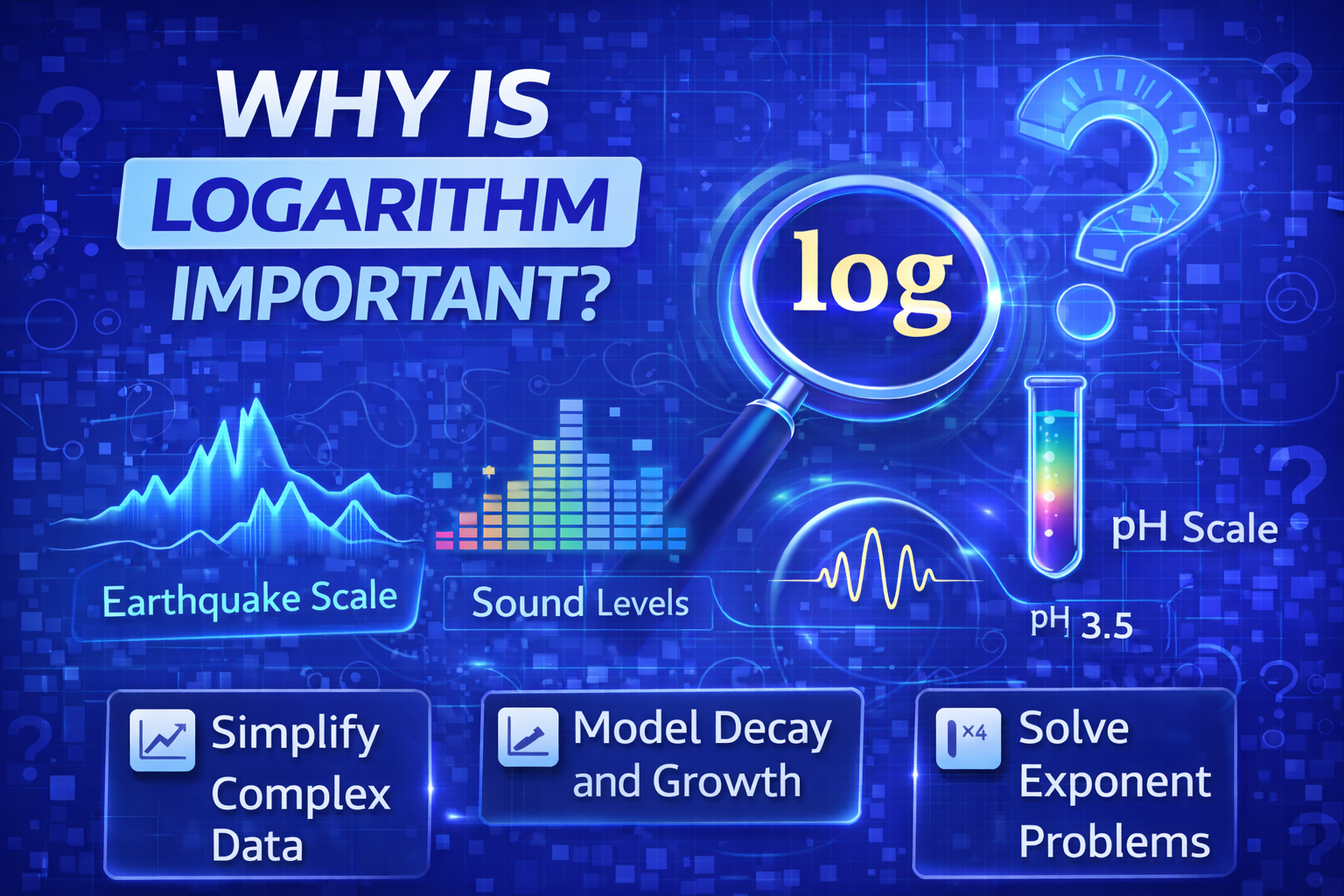
Understanding why is logarithm important changes the way you see mathematics, science, and technology. You use logarithms whenever you measure sound, analyze growth, calculate interest, or solve exponential equations.
If you want sharper problem-solving skills and deeper insight into real-world data, you need to grasp how logarithms turn complex relationships into manageable numbers.
Logarithms Turn Exponents into Solvable Equations
You often face equations where the variable sits in the exponent, and that makes direct solving impossible without logarithms. When you rewrite an exponential equation such as 2^x = 16 into logarithmic form, you isolate the unknown exponent and solve it precisely. This ability to convert exponential growth into a clear exponent value explains why is logarithm important in algebra and beyond.
Logarithms act as the inverse of exponentiation, meaning they undo the effect of raising a number to a power. If b^x equals n, then log base b of n equals x, which gives you direct access to the hidden exponent. Without logarithms, solving exponential models in finance, physics, or population studies would require inefficient guesswork instead of precise calculation.
When you understand this inverse relationship, you gain full control over equations involving rapid growth or decay. You can solve for time in compound interest formulas, determine half-life in chemistry, or find unknown growth rates in technology adoption curves. That practical power alone shows why is logarithm important in higher-level mathematics.
Logarithms Simplify Multiplication and Division
One major reason why is logarithm important lies in its ability to transform complicated operations into simpler ones. The product rule allows you to convert multiplication into addition, and the quotient rule converts division into subtraction. This transformation historically reduced massive numerical calculations into manageable steps before modern calculators existed.
When you multiply very large numbers, adding their logarithms is faster and less error-prone. Engineers and scientists relied on logarithmic tables for centuries to perform high-precision calculations efficiently. Even today, the underlying principle powers algorithms and computational models used in data science and artificial intelligence.
You benefit from this simplification whenever you break complex expressions into smaller components. The power rule further allows you to move exponents in front of a logarithm, turning exponentiation into multiplication. These properties together make logarithms an essential tool in advanced mathematical modeling.
Logarithms Model Real-World Measurement Scales
You encounter logarithms in everyday measurement systems more often than you realize. The Richter scale for earthquakes and the decibel scale for sound intensity both use logarithmic relationships. Because each unit increase represents a multiplicative jump rather than a simple addition, logarithms compress enormous ranges into readable values.
In chemistry, the pH scale measures acidity using a base-10 logarithmic formula tied to hydrogen ion concentration. A small change in pH represents a tenfold change in acidity, which would be difficult to express on a linear scale. That compression illustrates exactly why is logarithm important when representing extreme scientific variations.
Astronomy also uses logarithmic scales to describe stellar brightness, where differences span astronomical magnitudes. Without logarithms, comparing these immense values would be impractical. By converting exponential intensity into manageable numbers, logarithms allow scientists to interpret the universe accurately.
Logarithms Help You Understand Growth and Decay
Exponential growth and decay appear in finance, biology, and technology adoption. Whether you track compound interest, bacterial growth, or radioactive decay, you rely on logarithms to calculate time or rate accurately. They allow you to solve equations where the variable appears in the exponent, which is common in real-world modeling.
For example, if you invest money at a fixed interest rate and want to know when it doubles, you must use a logarithm to isolate time. The same principle applies when scientists calculate half-life in radiocarbon dating or pharmacology. Without logarithms, predicting these processes would lack precision and reliability.
You also see logarithmic growth patterns in technology and network systems. As data storage increases exponentially, logarithmic measures help interpret scale and efficiency. That adaptability across fields reinforces why is logarithm important in modern society.
Logarithms Improve Scientific and Engineering Accuracy
When you solve engineering equations, you often manipulate exponential expressions. If you want precise results, you must understand how to apply logarithmic properties correctly. Many students strengthen these skills by practicing with tools such as Scientific Calculator Online, which allows you to evaluate log expressions quickly and accurately within realistic problem scenarios.
You also encounter logarithmic functions when analyzing electrical circuits, heat transfer models, and signal processing systems. The natural logarithm, written as ln, plays a central role in calculus because it connects directly to the exponential function e^x. Its derivative properties simplify integration and differential equation solving.
These applications demand accuracy, especially in fields where small miscalculations can lead to costly errors. Logarithms give you structured rules that reduce computational risk. That reliability makes them indispensable in engineering design and scientific research.
Logarithms Support Algorithm Efficiency in Computer Science
You frequently hear about logarithmic time complexity in computer science. When an algorithm runs in O(log n) time, performance improves dramatically compared to linear growth as data expands. This efficiency explains why search algorithms and data structures rely on logarithmic behavior.
Binary search, for example, cuts data sets in half repeatedly, producing logarithmic scaling. As your data doubles, the number of steps increases only slightly, making large-scale computation feasible. This principle illustrates why is logarithm important in high-performance computing and software development.
Logarithms also help determine how many bits are required to represent a set of possible values. In information theory, the number of bits needed equals the logarithm base two of total possibilities. That calculation directly impacts data compression and encryption systems.
Logarithms Strengthen Financial Decision-Making
You rely on logarithms when analyzing investment growth or comparing interest rates. Compound interest follows exponential patterns, and isolating time or growth factors requires logarithmic manipulation. Without this skill, long-term financial planning would depend on rough estimates instead of accurate forecasting.
If you want to solve equations involving powers efficiently, you can practice exponent handling techniques discussed in how do you raise to the power on a scientific calculator, which builds the foundation needed for correct logarithmic conversions. Mastery of exponent entry reduces errors when working with financial or scientific growth models.
Logarithms also allow you to compare investments that grow at different rates over time. Instead of guessing outcomes, you compute precise break-even points. That analytical clarity explains why is logarithm important in responsible financial planning.
Logarithms Build a Foundation for Advanced Mathematics
You cannot progress confidently into calculus without understanding logarithms. The natural logarithm function is the inverse of e^x, and it appears in derivatives, integrals, and differential equations. These tools form the backbone of physics, engineering, and economic modeling.
When you solve integrals involving rational functions, logarithmic expressions frequently appear in final solutions. The ability to manipulate log properties determines whether you reach correct answers efficiently. Mastery at this level ensures smooth transition into higher-level mathematical analysis.
You also develop logical thinking by applying logarithmic identities consistently. Rules such as log base b of 1 equals zero and log base b of b equals one become intuitive with practice. That conceptual fluency strengthens your analytical confidence.
Logarithms Make Data Interpretation Clearer
Modern analytics often involve interpreting exponential patterns in data sets. When you transform exponential trends into logarithmic form, you often produce linear relationships that are easier to analyze statistically. This transformation simplifies regression modeling and forecasting accuracy.
Researchers commonly use log transformations to stabilize variance in skewed data. Doing so improves model reliability and clarifies trends that would otherwise remain hidden. If you refine your analytical writing skills through structured practice like tips for concise scientific writing, you will present logarithmic findings clearly and convincingly.
Clear communication matters as much as mathematical precision. Logarithms provide the structure, but your explanation ensures impact. That combination elevates both academic and professional performance.
Logarithms Reduce Cognitive Overload
You process enormous numerical ranges more easily when they appear on a logarithmic scale. Instead of dealing with extreme exponential values, you compress them into manageable units. This compression reduces mental strain during calculation and interpretation.
Before electronic calculators, scientists used log tables to avoid lengthy multiplication and division. The principle remains relevant because it trains you to think efficiently about scale and proportional change. By internalizing log properties, you solve complex expressions with less cognitive effort.
That efficiency matters in high-pressure environments where speed and accuracy determine outcomes. Logarithms provide structured shortcuts grounded in solid mathematical logic. This balance between simplicity and power highlights why is logarithm important across disciplines.
Logarithms Enhance STEM Education and Critical Thinking
When you study logarithms deeply, you strengthen reasoning skills beyond mathematics. You learn to convert between exponential and logarithmic forms seamlessly, reinforcing conceptual flexibility. This adaptability builds resilience in tackling advanced STEM challenges.
Many modern educational tools emphasize logarithmic reasoning because it connects algebra, calculus, and data science. By practicing systematic expansion and compression of log expressions, you sharpen pattern recognition abilities. That structured thinking benefits engineering, economics, and even digital analytics.
As you apply logarithms to real-world scenarios, you recognize their unifying role across disciplines. They bridge abstract theory with practical measurement systems. That connection ultimately answers the question why is logarithm important in both education and industry.
Conclusion
You now understand that logarithms are far more than abstract algebraic tools. They simplify complex operations, model real-world scales, power algorithm efficiency, and guide financial and scientific decision-making. From earthquake measurement to compound interest and computer algorithms, logarithms convert exponential growth into understandable insight.
When you apply logarithmic properties confidently, you reduce computational errors and strengthen analytical reasoning. You gain the ability to interpret extreme values, isolate unknown exponents, and communicate results clearly. That mastery ultimately explains why is logarithm important in every modern, data-driven discipline you encounter.